
Clan MacEwen
A brief History
Clan MacEwen, Clann Eoghain — is an ancient and enigmatic Highland clan, with roots that stretch deep into the soil of Argyll and the storytelling loam of Ulster. Our heartland was once the Barony of Otter, in Cowal, with lands that stretched across Loch Fyne, through Kilfinan, and into the surrounding districts of Glassary, Lorne, Knapdale, and Kintyre. But like the loch itself, our origins reflect many sources flowing together.
Descent from Kings — Irish and Scottish
According to both tradition and genealogical conjecture, Clan MacEwen of Otter descends from Ánrothán Ua Néill, an Irish prince of the O’Neill dynasty who left Ireland for Kintyre in the 11th century. Ánrothán was the son of Áed, himself son of Flaithbertach Ua Néill, King of Ailech and of the Cenél nEógain. This royal line traces further back to Niall Noígíallach — Niall of the Nine Hostages — High King of Ireland in the 4th and 5th centuries.
From this shared royal ancestry, MacEwen is kin to many Argyll families: the Lamonts, MacLachlans, MacNeils of Barra, MacSweens, and others. Indeed, the Kilbride Manuscript of 1540 and the Lyon Court conjectural tree place the clans of Cowal in a broad familial group that descends from Irish kings and the Kingdom of Aileach — a reminder of the long interweaving of Irish and Scottish Gaelic identity.
The MacEwens of Otter
The most distinct and unified body of MacEwens was found at Otter, on the rocky shores of Loch Fyne, where the ruins of Caisteal Mhic Eoghain — MacEwen Castle — still stand near Kilfinan. The Statistical Account of Kilfinan (1795) described it as a tall, irregular pentagonal structure, built of unmortared stone, standing proudly among grazing lands and glens once dotted with hundreds of MacEwen farms.
The Barony of Otter was formally held by the MacEwen chiefs until March 1432, when Swene MacEwen resigned the title to King James I. Though reinstated, the barony was destined for Gillespie Campbell, heir to Duncan Campbell of Lochow. When Swene died in 1493, the lands were officially handed to the Campbells by 1510 — a shift that archaeological evidence suggests may have been enforced by fire.
Yet even after the loss of chiefship, MacEwens remained in Cowal, with traditions asserting a migration into the Lennox under their own banner and arms granted by Mary, Queen of Scots, before her defeat in 1568 .
A Wider Footprint in Argyll
Though often limited in modern retellings to the Otter estate, the MacEwen presence was far broader. They held lands as far as Glen Array, Loch Awe, and the lower reaches of Glencoe. Their defensive structures — vitrified forts and hilltop strongholds — formed a network across Cowal, mirroring those in Glen Lednoch in Perthshire. Flint tools found at Kilfinan even trace trade or travel to the Antrim coast and Inish Eoghain — a connection to our namesake, Eoghain, son of Niall, whose kingdom included that region.
Kinship and Complexity
The name MacEwen (MacEoghain) is patronymic and not exclusive to Otter. Several clans have lines bearing the name Eoghain, and some MacEwens descend from different origins — including branches tied to the MacDougalls, Campbells, or other Gaelic families. Still, many of these are kin: among our documented cousins are MacGilchrists, Camerons, MacGregors, MacLeans, Fergussons, and MacPhersons.
MacEwens also held roles as bards, harpers, and senachies (historians) in the Highlands and Isles, serving noble houses like the MacDougalls and the Lordship of the Isles. A rich oral and literary tradition lies just beneath the surface of our clan’s story.
Diaspora and Legacy
Following the collapse of the Otter line, and again during the clearances of the 18th and 19th centuries, MacEwens dispersed widely. Many settled in Ayrshire, the Lennox, Perthshire, and Renfrewshire. From there they spread further — to the Americas, Australia, New Zealand, and South Africa. Place names such as Colmonell (from Kilcolmonell in Kintyre) and Almont (from Ayrshire) trace their footsteps abroad.
Today, settlements in Canada, the United States, and beyond still bear the imprint of Clan MacEwen — a people of glens, drovers’ paths, and transatlantic voyages. Whether fleeing oppression or seeking opportunity, our ancestors carried more than their name — they carried memory, tradition, and community.
Modern Leadership and Revival
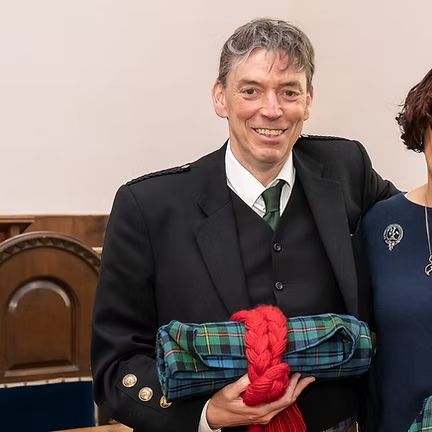
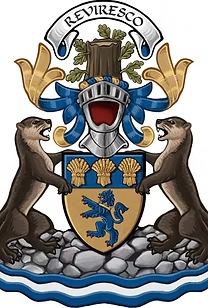
 After centuries without a recognized leader, Clan MacEwen entered a new chapter in the 21st century. In 2012, the Lord Lyon initiated the process of identifying a potential chief through a Family Convention (Derbhfine). This led to the nomination of Sir John Roderick Hugh McEwen, 5th Baronet of Marchmont and Bardrochat — a descendant of the McEwen Baronets of Carrick. In 2025, the Lord Lyon officially recognised Sir John as the Chief of the Name and Arms of MacEwen, marking the revival of the clan’s leadership for the first time since the death of Swene MacEwen in 1493.